
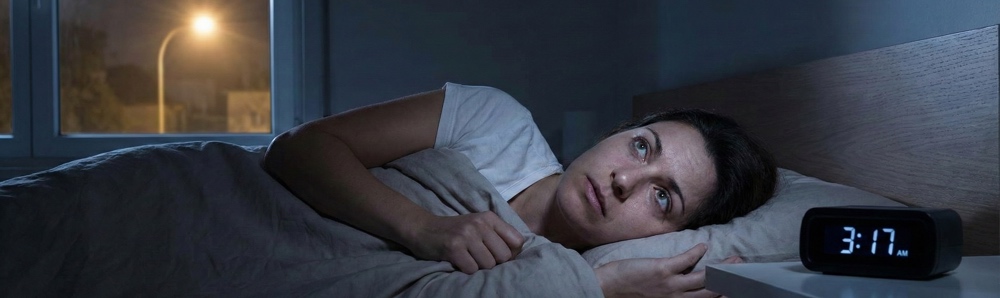
The day finally winds down, the lights go off, the head hits the pillow, and the brain takes that as a starting gun. Worries that were manageable at noon suddenly feel urgent at midnight. Old conversations replay. New worries volunteer themselves. The body that should be settling into sleep instead becomes more alert, more tense, more awake. Nighttime anxiety is one of the most common patterns we hear from clients, and it is not in your head in the dismissive sense. It is a predictable interaction between circadian biology, sleep architecture, and the way the anxiety system actually works. At OCD Anxiety Centers, we treat the anxiety disorders that drive this pattern through Exposure and Response Prevention (ERP) and related evidence-based approaches in our 16-week intensive outpatient program.
This article walks through why anxiety so reliably escalates at night, what the underlying mechanisms are, and what evidence-based treatment offers for people who have started dreading bedtime.
Key Takeaways
- Nighttime anxiety is a predictable pattern driven by reduced distraction, circadian biology, and sleep-anxiety feedback loops.
- The brain has fewer competing inputs at night, which gives existing worry more space to amplify.
- Anxiety and sleep have a bidirectional relationship: anxiety disrupts sleep, and poor sleep amplifies anxiety the next day.
- Avoiding bed or fighting the anxiety usually makes the pattern worse rather than better.
- Evidence-based treatment addresses the underlying anxiety disorder, which typically resolves the nighttime spike.
- Treatment at OCD Anxiety Centers achieves an average 67% symptom reduction and a 79% recovery rate.
Why Does Anxiety Spike at Night?
Reduced Distraction
During the day, the brain has constant competing inputs: work, conversations, errands, screens, decisions. These inputs occupy cognitive resources and crowd out background worry. At night, the inputs disappear. The brain still has the same amount of worry to generate, but suddenly the only thing on the agenda. What felt manageable at 2 pm becomes overwhelming at 11 pm not because the worry got worse, but because everything else got out of the way.
Circadian Biology
The body’s stress hormones, including cortisol, follow a daily rhythm. Cortisol is highest in the early morning and declines through the day, but in some people with anxiety disorders, this rhythm becomes dysregulated, with elevated arousal at evening hours when the system should be quieting. Body temperature and heart rate also follow circadian patterns that affect how the body interprets internal signals at night.
Cumulative Fatigue
The cognitive resources that help regulate emotion deplete across the day. By evening, the prefrontal mechanisms that keep worry in check are tired, while the limbic system that generates anxiety responses remains active. The brain becomes worse at putting worry in perspective at exactly the time of day when fewer external supports are available.
The Pressure to Sleep
Once a person has had a few bad nights, the bed itself becomes associated with anxiety. The brain learns: bed equals lying awake worrying. This is a kind of conditioned response, and it produces a particularly cruel feedback loop in which the harder a person tries to fall asleep, the more the anxiety system activates around the goal of sleeping.
Rumination Without Resolution
Daytime worry often points toward action: a call to make, a problem to address, a task to complete. Nighttime worry has no available actions. The bills cannot be paid at 3 am. The conversation cannot be had at 3 am. The work cannot be done at 3 am. The brain runs the same loops without the discharge that action provides, and the loops intensify rather than resolve.
Sleep Deprivation Itself Amplifies Anxiety
Once sleep starts to suffer, the next day brings worse anxiety, which produces worse sleep, which produces worse anxiety. This is a classic feedback loop, and breaking it usually requires addressing both the underlying anxiety disorder and the disrupted sleep system at the same time.
What Does Nighttime Anxiety Look Like in Different Disorders?
Generalized Anxiety Disorder
The worry process activates in bed, often shifting topics rapidly. Bills, deadlines, family, health, world events, the past, the future. The mind cycles for hours, generating concerns and refusing to set them down. Difficulty falling asleep is the most common pattern.
OCD
Intrusive thoughts can intensify at night, and mental rituals expand to fill the available time. Reassurance-seeking, mental reviewing, and checking compulsions often spike before bed. Some clients describe an hour or more of mental ritualizing before they can sleep.
Panic Disorder
Nocturnal panic attacks wake people from sleep, often in the early hours of the morning, with the same symptoms as daytime attacks. The fear of having another attack can produce anticipatory anxiety that delays sleep onset.
Social Anxiety
Post-event analysis often peaks at night, with the person reviewing every interaction from the day, looking for evidence of failure. Anticipatory worry about the next day’s social demands also amplifies in the quiet of evening.
Health Anxiety
Body sensations that go unnoticed during the day become loud at night. Heart rate, breathing, muscle twitches, and stomach noises feel more pronounced and more alarming. The brain interprets the heightened body awareness as evidence of threat.
Why Doesn’t Sleep Hygiene Alone Fix It?
Standard sleep hygiene advice (consistent bedtimes, limit screens, dark room, no caffeine in the afternoon) is genuinely useful and worth following. It is not, however, sufficient when an anxiety disorder is driving the nighttime pattern. Sleep hygiene is calibrated for ordinary sleep difficulty in people without an underlying anxiety disorder. When anxiety is the driver, perfect sleep hygiene can still be defeated by the worry process itself.
This is part of why people with anxiety often feel like they are doing everything right and still cannot sleep. They are doing everything right for a different problem. The right solution for an anxiety-driven sleep pattern is to treat the anxiety, which typically restores sleep without further intervention.
How Is Nighttime Anxiety Treated?
The most effective approach addresses the underlying anxiety disorder rather than treating nighttime anxiety as a separate problem. Exposure and Response Prevention and related cognitive behavioral approaches retrain the brain’s threat-response system through gradual, structured practice. Treatment also includes specific work on the bed-anxiety association, the worry process that activates at night, and the urge to engage with worries that have no available action.
At OCD Anxiety Centers, anxiety disorders are treated through our 16-week intensive outpatient program. Clients participate in three hours of clinical treatment per day, Monday through Friday. Adult sessions run 12 to 3 pm. Adolescent sessions run 3 to 6 pm. The intensive format produces enough cumulative work to genuinely shift the anxiety system, which typically resolves the nighttime amplification along with the daytime symptoms. Our outcomes show an average 67% symptom reduction, a 79% recovery rate, 92% client and parent satisfaction, and 95% of clients use insurance to cover care.
Nighttime Anxiety Myths and Facts
The myths around nighttime anxiety often involve well-intentioned advice that can actually reinforce the pattern.
Myth: If you cannot sleep, you should just lie in bed and try harder to relax.
Fact: Lying in bed unable to sleep teaches the brain that the bed is a place for being anxious. Sleep behavior research consistently recommends getting out of bed if sleep does not come within about twenty minutes, doing something low-stimulation in another room, and returning to bed only when sleepy. The bed should be reserved for sleep.
Myth: Better sleep hygiene will solve the problem.
Fact: Sleep hygiene is helpful but not sufficient when an anxiety disorder is driving the pattern. Treating the underlying anxiety typically restores sleep without further intervention; treating sleep alone often does not address the anxiety.
Myth: You should engage with your nighttime worries to resolve them.
Fact: Engaging with worry at night usually amplifies it. The brain has no available actions, the cognitive resources are depleted, and the rumination produces no resolution. Treatment teaches clients to recognize the worry process and disengage from it rather than chasing the content.
Myth: Drinking alcohol or using sleep aids regularly is a reasonable long-term solution.
Fact: Substances that produce sedation often disrupt sleep architecture and can worsen anxiety over time. They also function as compulsions, teaching the brain that the situation is intolerable without them. Treatment addresses the underlying disorder so that natural sleep returns.
Myth: Once nighttime anxiety has started, it is just how you sleep now.
Fact: Nighttime anxiety is a learned pattern that responds to evidence-based treatment. Most clients who recover from their underlying anxiety disorder experience substantial improvement in sleep, often within the first weeks of treatment.
What to Expect from Treatment
Treatment begins with a thorough assessment of which anxiety disorder is driving the pattern, what the nighttime presentation looks like specifically, and what behaviors have built up around bedtime. Clinicians design exposure exercises calibrated to each client’s pattern, including work on the worry process itself, the bed-anxiety association, and the underlying anxiety disorder.
Most clients begin to notice improved sleep within the first several weeks of treatment, often before they notice major changes in daytime anxiety. Sleep tends to recover relatively quickly once the anxiety system starts to settle, and better sleep then accelerates the rest of recovery. By the end of the 16-week program, the majority report substantial improvement in both anxiety and sleep, along with a fundamentally different relationship to bedtime.
A Way Forward
If your bedroom has become a place where you brace for the next round rather than rest, you are not broken or doing something wrong. You are experiencing a predictable feature of how anxiety interacts with the night. The pattern is real, the mechanism is identifiable, and the treatment works. Recovery does not mean never having a difficult night again. It means the difficult nights stop being the rule.
Frequently Asked Questions
Why does my anxiety hit hardest right when I am trying to fall asleep?
Several factors converge at bedtime: reduced distraction, depleted cognitive resources, circadian shifts, and the pressure of trying to sleep. The brain has more space for worry and fewer tools to regulate it, which is why anxiety reliably escalates at this time of day.
Will treating my anxiety improve my sleep?
Yes, in most cases. Sleep tends to recover as the underlying anxiety disorder is treated, often within the first several weeks. At OCD Anxiety Centers, our program achieves an average 67% symptom reduction, and clients commonly report sleep improvement as one of the earliest changes.
Is it okay to take sleep aids while in treatment?
Medication decisions are individualized and made with the client’s medical providers. From a behavioral standpoint, treatment focuses on building the brain’s ability to settle into sleep without aids over time, regardless of whether short-term tools are part of the picture.
Should I get out of bed if I cannot sleep?
Yes. Sleep research consistently recommends getting out of bed if sleep does not come within about twenty minutes, doing something low-stimulation in another room, and returning to bed only when sleepy. This protects the bed-sleep association.
Can nighttime anxiety happen even when I am not stressed during the day?
Yes. The mechanisms that produce nighttime amplification (reduced distraction, circadian biology, cognitive depletion) operate regardless of whether the day was particularly stressful. People with anxiety disorders often experience nighttime spikes even after relatively calm days.
Does insurance cover treatment for anxiety-driven sleep problems?
Insurance covers treatment for the underlying anxiety disorder, which typically addresses the sleep problems as well. At OCD Anxiety Centers, 95% of our clients use insurance to access care.
Is virtual treatment effective for nighttime anxiety patterns?
Yes. Our virtual intensive outpatient program delivers the same evidence-based treatment, the same 16-week structure, and the same outcomes as in-person care. Virtual treatment is often particularly accessible for clients whose sleep patterns make morning routines difficult.
If your nights have become the hardest part of your day, evidence-based treatment can change that. OCD Anxiety Centers offers a 16-week intensive outpatient program built around Exposure and Response Prevention, calibrated for the anxiety disorders that drive nighttime amplification. Call 866-303-4227 to talk through your situation with our admissions team.